
Today my lovely barista asked me how I was doing, and I said, “Huh… good… again.”
It’s surprising. Maybe it’s that I came into a bit of money, so I’m relaxed about money. Or that my panic disorder seems to be retreating (though I hate to comment on that, and must knock on wood). Maybe it’s that I made a hard choice not to go to a big family event out of town, because I felt like I wasn’t ready to try big travel yet, at least not so soon after school has gotten out.
Maybe it’s that I’m leaning into trusting that many people are working against fascism right now, including many churches.
Let’s not look a gift horse in the mouth.
Let’s instead add to our joy by thinking of Andrzej Tadeusz Bonawentura Kościuszko.
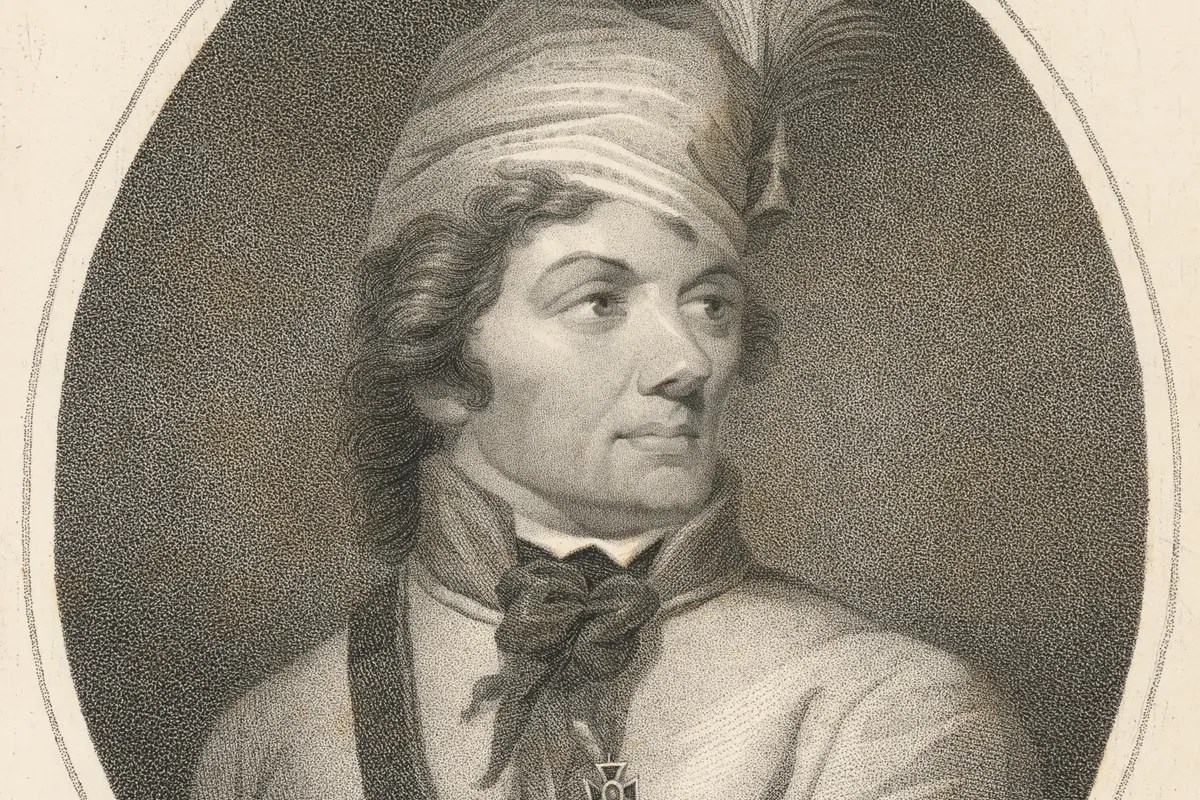
Koscuiszko’s name is familiar to me because I spent a fair amount of summertimes near Koscuiszcko, Mississippi, a.k.a, Oprah’s birthplace, a.k.a, the nearest town with a Wal-Mart. Relatives lived in a tiny Mississippi town with a summer camp, and a trip to Kozi was kind of a big deal.
His name is also familiar to me from running into him in Brooklyn, where he has a street and a subway station.
Much like the Marquis de Lafayette (one of my heroes, and namesake of my cat), and President Franklin Delano Roosevelt (also my man), Kos was a nobleman with a heart for the little guy. When he’s born, his family “owned” 31 peasant families, and when he dies 71 years later, he leaves money to fund the freedom of enslaved Amerians. Kos was good buddies with Jefferson, and he had the balls to earmark some of that money to free the people Jefferson enslaved.
(Okay, ultimately this didn’t happen, as it’s hard to make people do things like this after you die in 1817. But after multiple challenges to the will, including trips to the Supreme Court, eventually some of it was used to found a school for Black Americans in New Jersey.)
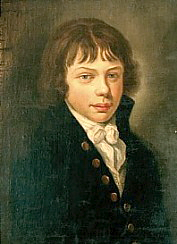
He was a second son, so he got into military stuff. In 1758, he had to drop out of school because his dad died and money became a problem.
When fighting arose in Poland, related to throwing off Russian rule, Kos wasn’t sure if he was for quick independence, especially because people who supported him were for gradual independence. So he checks in with an artist buddy, gets help from the king, and off he goes to Paris.
In Paris, Kos is not technically allowed to study at a military academy. I guess you don’t want to train your possible future enemies. So he studies drawing, painting, and architecture, and military strategy other places. He hears a lot about the Enlightenment, which jibes with the religious toleration in Poland/Lithuania that he likes.
Aside: some people say ol’ Kos was gay, and hey, maybe he was! But I used to think my brother might be gay, because he wanted to wear my makeup when he was a child… turns out he’s straight. (I still love him.)
The American Revolution gets going, and Kos (like Lafayette, my baby) is like, let’s go! Kos was broke, and passionate, so he was ready to roll the dice.He sails to the colonies, and goes straight to Benjamin Franklin’s print shop (I see you, Philly! I’ve been to that print shop and bought the printed Declaration!)

Sorry, I have to type that again: he goes to Benjamin Franklin’s print shop. LIKE YOU DO.
He tells Ben, “I don’t have any letters of recommendation. Could I maybe take an engineering test to prove to you I’m trustworthy?”
Ben, the kind of man who had a pet squirrel and wrote an article entitled, “Fart Proudly,” said, “Go join the Continental Army, my child.”
In upstate New York, Kos proceeds to correctly diagnose and fix all kinds of engineering problems for the rebel forces, like using trees and rocks and stuff to protect troops. (I think. I’m not an engineer.)
Throughout the American Revolution, he carries a sword that had the following cautionary statement on it: Do not draw me without reason; do not sheathe me without honour.
If that doesn’t get you going, I don’t know what will.

He finds time in 1777 to compose a polonaise for harpsichord. This song becomes an anthem for Polish freedom fighters.
They give him an assistant who is black, and they are friends, becuase Kos wasn’t a racist piece of shit. (This guy, Agrippa Hull, is a subject for another day. Suffice it to say, he’s also a wow.)

He helps shore up West Point (still going strong today).
He asks to go south, and ends up in Virginia, scouting locations for camps, figuring out where and how to cross rivers, and trying to hook up with would-be spies. He ends up leading a ring of spies who are black. Like, I guess they trust him? I know.
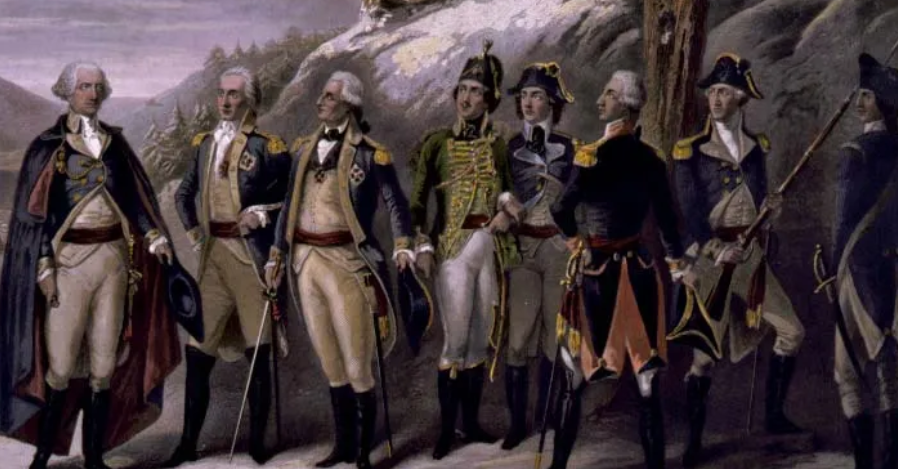
In 1781, he takes part in battle, and sustains his only wound: getting stabbed in the fanny. Probably stayed off horseback for a while.
We win the war!

Kos is asked by Congress to supervise a fireworks display in Princeton, New Jersey. I don’t know what to make of that, exactly, but it’s cool.
Back in Poland/Lithuania, he fights for Jews and peasants to be made full citizens, because he isn’t a racist piece of shit. He kicks ass in the Polish-Russian War of 1792, but this is ultimately a huge bummer. Poland didn’t get freed. In fact, he was fucking with Catherine the Great, and ended up in her prison.

In 1796, though, Catherine shuffles off her mortal coil, and the incoming czar frees him. He heads back to the U.S. The Americans, like all human beings, being ultimately untrustworthy, were suspicious of Kos. Though he had, with no profit to himself, assisted them in becoming free, people thought he was partisan, politically, and he was European.
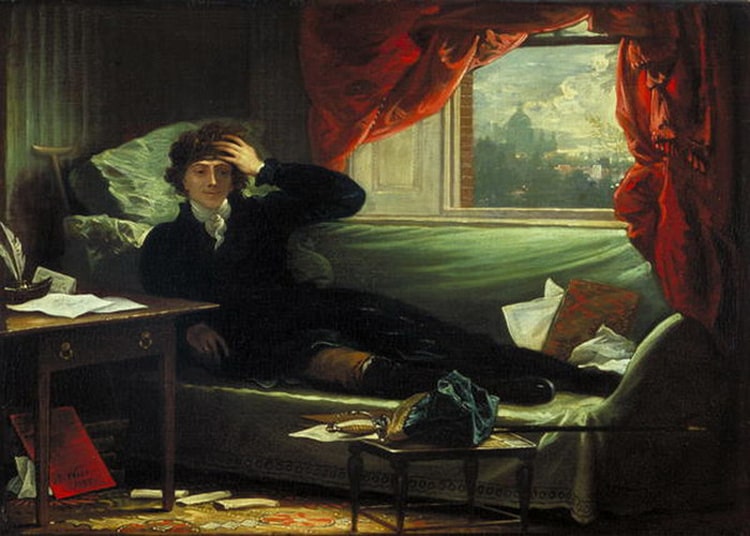
He meets with various prominent Americans while he’s in the U.S., including a leader of the Miami people named Mihšihkinaahkwa (called Little Turtle). I’m gonna circle back to him this summer, too. Mihšihkinaahkwa give him a peace pipe tomahawk, and Kos gives Mihšihkinaahkwa a cloak and a pair of glasses.

(Sorry, I really only included that story because I love the idea of a 6 foot tall leader whom white people call “Little Turtle,” and kicks ass.)

Kos heard news about more fighting for Poland/Lithuania, and got a fake passport from his buddy Jefferson to return to Europe.
In France again, Kos meets with Napoleon. Napoleon thinks Kos is an asshole because Napoleon is an asshole. Kos thinks Napoleon is a dictatorial prick, because Napoleon is a dictatorial prick. Napoleon conquers Poland. Kos asks if Napoleon could have a parliament, and, like, their own country, and Napoleon tells Kos to fuck off.
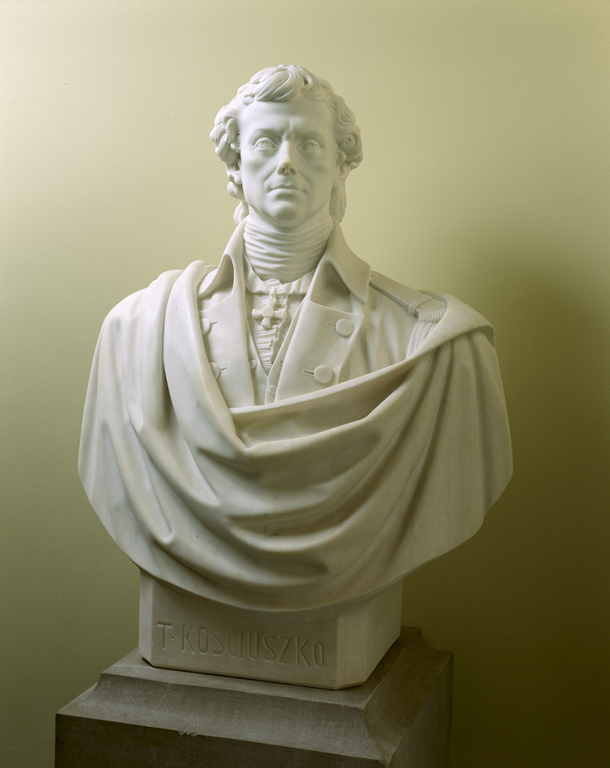
In 1817, he tries to free the last of “his” peasants. The czar is like, nah. Then Kos dies, aged 71. Not bad for a soldier 200 years ago.
I am Polish, and I take pride in the legacies of two Polish people: Chopin, and Koscuiszcko. Chopin for the beauty he left us, and Koscuiszko for his heart. Which happens to be in a special urn in a castle in Warsaw. The urn apparently looks like this:

If you didn’t find all that awesome, you might want to see a doctor.
Notes:
I found another urn that supposedly has his heart in it. My guess is that the first one was destroyed during World War II, and they made another. It’s less awesome, though still not bad:


