
I witnessed the beginning and end of a nun’s life last week. At the monastery I regularly visit, they had a transfer in, who did a slightly revised Final Vows (as she was already a nun, but with a different order), and the parts of a nun’s funeral, from reception of her cremains to burial of those cremains in the cemetery down the hill.
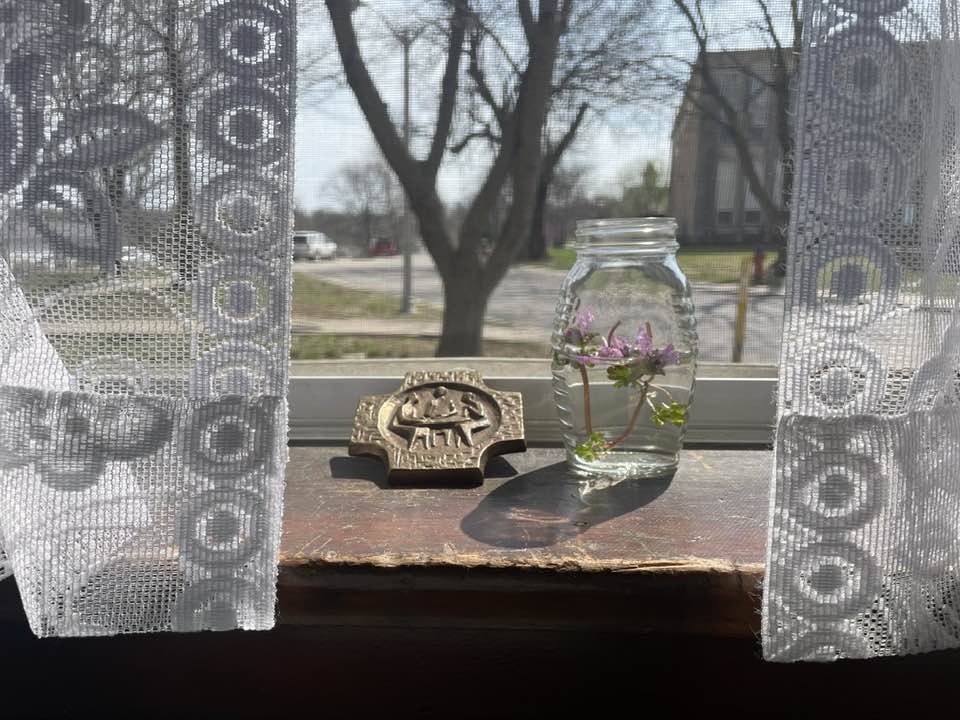
It felt tidy, in a very messy time.
Things start, things end. The sister who died was 97. Discussion was, who was now the oldest? That sister was probably 96. Clean living, somewhat. Living in community, definitely. As they age, the sisters move from their monastery room to a room in the nursing care center attached to the monastery. Things proceed in much the same way they always have. You can still eat in the cafeteria with everyone, and go to prayers.
I arrived, this time, pretty chill. It was halfway through my spring break. I’d already done a bit of traveling (my soul requires traveling). My teacher energy had fallen. I felt more like a person.
I had four-ish days to read, write, draw, nap, pray, and yoga.
The final profession came first. The Benedictines hold hospitality as one of their highest callings, so I was invited to the profession, and the funeral parts. Everyone is invited to everything.
During prayer that night, the new sister lay flat on the floor, and a white cloth was placed over her. “It used to be a black cloth, symbolizing your death, but now it’s white, because you’re being resurrected into becoming who you truly are,” said my nun friend who obviously was a fan of the Vatican II reforms.
“Did you guys wear wedding dresses at yours?” I asked a table of seventy- and eighty-somethings. I had read about this in nun memoirs, all written by nuns who had left, of course.
“No, we just got a special dress when we joined,” one said.
The Benedictines are not, as the priest said at mass, “flashy.”
The sister had written her statement of commitment, and took new and different vows. While her previous community had asked her to go with the usual, chastity, poverty, obedience, the Benedictines vow stability, fidelity to the monastic way of life, and obedience.
“When I was younger, I was attracted to the most hard-core monastics,” I told my nun friend. “You know, the silents, the cloistered, the Mother Teresas. Now I know Benedictines are good for me, they’re medium, they’re steady.”
After the profession, there was a receiving line. People were hugging the new sister. I wasn’t sure about the hugging, as I had never even officially met this person, but she was newly married to Jesus, and she warmly reached out to hug me anyway.
A word: technically these nuns don’t lean into the idea of marrying Jesus. But as a single person, it felt special to me, like I could relate to committing to something when it was just you making the decision. Vows are within your control. You can commit, and have everyone watch. I would not have a similar ceremony to become a teacher. I have had a similar ceremony to be baptized (but I was an infant) and to be confirmed (though that was 8th grade, a while back). I love ceremonies. I wish more churches had official healing ceremonies, and liturgies for stuff like, having bought a car you’re worried you can’t afford, or blessings for looking at a bank balance app on your phone.
The parts of the dying sister’s story came next. In between, I read Breathe, which is as good as everyone says, and I shall never breathe through my mouth again. I read a book about the Spanish peninsula from about 800 to 1200, learning about how the Muslims, Jews, and Christians got along and didn’t get along during that time. And I worked on bits of the Dali Lama’s book on how to be happy.
To go to the ceremony for receiving the sister’s ashes, I decided to walk outside. The weather was beautiful. I got to the door to the nursing home part of the building, and I saw all the nuns and a lot of the medical staff standing very quietly. I tried to make eye contact with the receptionist. She walked up. “Where are you going?” she mouthed. I mouthed, “There,” and pointed at the gathering. I had forgotten, but of course the doors are locked to protect sisters with dementia.
I tiptoed in and found a spot. The box of ashes, I noted, was about twice as large as the box of my cat’s ashes. Miranda was E.T. to my Elliot, and I’ll never be the same. Honestly, you would think people were more than twice as big as cats, but I guess it depends on the person, and the cat.
The box was doused with a branch, holy water sprinkled. Then someone carried it to the chapel, and had noon prayer as usual, except the nun got to attend in ash form.
When they used the word “sister” for her, it reminded me that like the religious sisters, my closest emotional attachments are sisters. I don’t have a spouse or my own children. The hurt of losing a sister, even a 97-year-old one, losing one piece of your community, made me teary, although I had never met or seen the woman who had died.
So that was part one. Part two was evening prayer with the ashes. Happily, about 20 members of the sister’s family attended. For someone without a spouse or children, someone who had outlived so many contemporaries, it was sweet to see all her twenty- and thirtysomething nieces and nephews. We prayed again, with slight differences nodding to the death of the sister. The most poignant was the repetition of what the new nun had said: “Receive me, O Lord, as you have promised, and I shall live; do not disappoint me in my hope.”
How odd, I thought, that a nun would consider being disappointed in God’s reaction to her becoming a nun. I imagined God would be thrilled. I’m from a different time. No: humility. Acceptance and awareness of how things go wrong in life, even for people who try hard.
After that service, we went to the cafeteria for cookies and punch and stories. One sister led us, and shared this story: the nun who had died– let’s call her Mary– was a nurse in the nursing home unit. The speaker said that when she was also working there, she used to hike up her pants a few inches and say, “Do you like my pretty legs?” which was a joke because she was a nun and likely wearing polyester pants, extra soft-bottomed SAS shoes, and a loose scrub top. One day, Mary told the woman, “I need to speak with you.” And the woman was nervous. Mary was known to be blunt. “Sister,” she said. “You don’t have pretty legs.”
We also heard a few stories from Mary’s family, one about how she liked to go to the boats, to go gambling, with one niece. “Is it okay if I say… gambling?” the niece asked. I didn’t know if nuns were allowed to gamble, and I guess she didn’t, either. Everyone chuckled. “She used to always find a way to sneak something back into the monastery to eat on Meatless Mondays.”
That also got a good laugh.
Mary had been a teacher, at first, and a former student of hers testified that she had taught them how to draw snowmen. All the nuns had been required to be teachers, at first, because the order supplied Catholic schools with teachers. After Vatican II, nuns were encouraged to find their own way, whether that was going to law school or nursing school. Many became teachers, professors, administrators, but Mary became a nurse. She preferred that.
After retiring from nursing, she got into painting. The hallway was lined with her paintings. Although she had taken up painting at the age of 77, she had still made a lot of paintings. The one I liked was a cowboy lighting a cigarette while leaning against a trash can. There was also a painting of snowmen.
The final ceremony, the next day, was a funeral mass that led to the burial. I have spent significant time in that cemetery, reading the dates and the names. The earliest birth, I noted on this trip: 1832. Mysteriously, there is a sister with my last name. That side of my family is decidedly protestant, and I have a very uncommon last name, so I always look at her name and wonder. Once I wrote a letter to my grandma, who had died, and buried it nearby. That grandma was a good Catholic.
Droopy pine trees surround the cemetery. In Kansas, even the extreme east of Kansas, trees weren’t all over the place. White people planted trees, many trees, where they wanted them. At my great-grandparents’ farm, about 15 miles from the monastery, they had planted a similar windbreak of evergreens. They stand like unsupported soldiers, strong, thick, deep roots, but no reinforcements against the wind that can blow hard and long.
Out of the chapel we followed the ashes, and the crowd split into two. One was walking down the hill to the cemetery, the other was riding. I was following a sister friend, and she said, “Do you want to walk or ride?” “I don’t care, whatever’s easiest. I can walk,” I said. “Well,” she said. “Well, why don’t you just come with me.” “Okay,” I said. “What are we riding in? A chariot?” “No,” she laughed. “We’re not that high up in things.”
So I got into one of the nuns’ Toyota Corollas (the official car of nuns, BTW). I took the middle seat, as three elderly sisters were discussing who would sit in the middle of the back seat, and were not even considering that my 48-year-old body might have an easy time of getting in the middle.
“You don’t have to fasten your seatbelts. I’ll be very careful. But if you want to, I’d feel better.” We were not leaving the property, just taking a turn and a downhill slope, but I’m a safety girl (and an aunt of mine died in a car accident), so I wriggled around and assisted with seatbelts.
At the cemetery, the wind was blowing. It blew and blew. I awkwardly wrapped my hoodie around me, covering my summer dress.
I had been down there the day before, but I hadn’t seen a grave dug. The sister who dug it must have done it later on. The hole you need for a box of ashes, I noted approvingly, is much easier to dig than one for a body. A person could reasonably do it.
Prayers, a repetition of “Receive me, O Lord, as you have promised, and I shall live; do not disappoint me in my hope,” and some singing, maybe to the Virgin Mary, ending with setting the ash box in, and a nun holding a large stainless steel bowl of dirt while people processed by to take their handful and drop it in the grave.
I don’t remember if I’ve done this before.
I watched, noting which of the sisters quickly brushed their hands off, which seemed to gingerly touch the dirt, and which dug in. A couple next to me who were relatives of the deceased sneaked onto the other side of me, where people who had already put in their dirt were standing. I was fine with helping with dirt, but I also felt awkward, like the “Fight Club” guy at a support group. I moved toward them, and didn’t take a turn.
And then back up the hill. I walked, this time, behind a pair of sisters who were discussing how the priest had used a lot of incense. I was grateful. It had been ages since I’d breathed in a good censer cloud. It helps.

 Going On